A systematic comparative study of classical machine learning techniques for binary document classification, evaluating five feature extraction strategies across five classifiers on a multi-source news corpus.
We tackle the binary classification problem of distinguishing sports articles from political coverage—not because the task is intrinsically hard, but because the simplicity of the label space lets us rigorously isolate how different feature representations interact with different classifier architectures. The pipeline spans everything from multi-source data ingestion and NLTK-driven preprocessing to systematic evaluation across 25 experimental configurations.
BBC News Archive, template-driven synthetic generation, and real-time Indian news via NewsAPI—three data streams blended to ensure diversity in writing style, temporal coverage, and geographic focus.
Five feature extraction methods (BoW and TF-IDF with varying n-gram ranges) crossed with five classifiers (NB, LR, SVM, RF, GB), yielding 25 configurations evaluated on six metrics each.
Publication-quality figures—heatmaps, radar charts, confusion matrices, cross-validation error bars—generated automatically by a dedicated ExperimentVisualizer class at 300 DPI.
The corpus assembles real editorial content, controlled synthetic data, and live API-fetched news articles into a single cohesive dataset for classification.
Lowercasing, URL/email removal, punctuation stripping, NLTK tokenization, English stopword removal, and WordNet lemmatization—applied uniformly to every document before vectorization.
CountVectorizer (BoW) and TfidfVectorizer with sublinear TF scaling, max_features=5000, min_df=2, max_df=0.95. Evaluated at unigram, bigram, and trigram configurations.
80/20 stratified split (random_state=42) preserving class proportions. 5-fold stratified cross-validation on the training set to assess generalization stability.
Five classifiers spanning probabilistic, linear, and ensemble paradigms—each evaluated across all five feature representations.
Probabilistic baseline assuming feature independence. Blatantly violates linguistic reality, yet rarely harms classification performance on text. Fast to train, interpretable.
L2-regularized linear model (max_iter=1000). Outputs calibrated probabilities via the sigmoid function. A formidable competitor in high-dimensional sparse settings.
Linear-kernel SVM maximizing the margin between class boundaries. Probability estimates enabled via Platt scaling. Long track record of excellence on text classification.
Ensemble of 100 bootstrapped decision trees. Captures non-linear interactions and provides feature importance, but tends to underperform linear models on sparse text features.
Sequential ensemble of 100 boosted trees correcting residual errors. Dominates tabular benchmarks, but struggles with the extreme sparsity of text vectorizations.
Complete metrics for all 25 configurations. Click column headers to sort. Toggle between metrics using the buttons below.
| # | Feature Method | Classifier | Accuracy | F1 Score | Precision | Recall | CV Mean | ROC-AUC |
|---|
Publication-quality figures generated at 300 DPI. Click any image to expand.
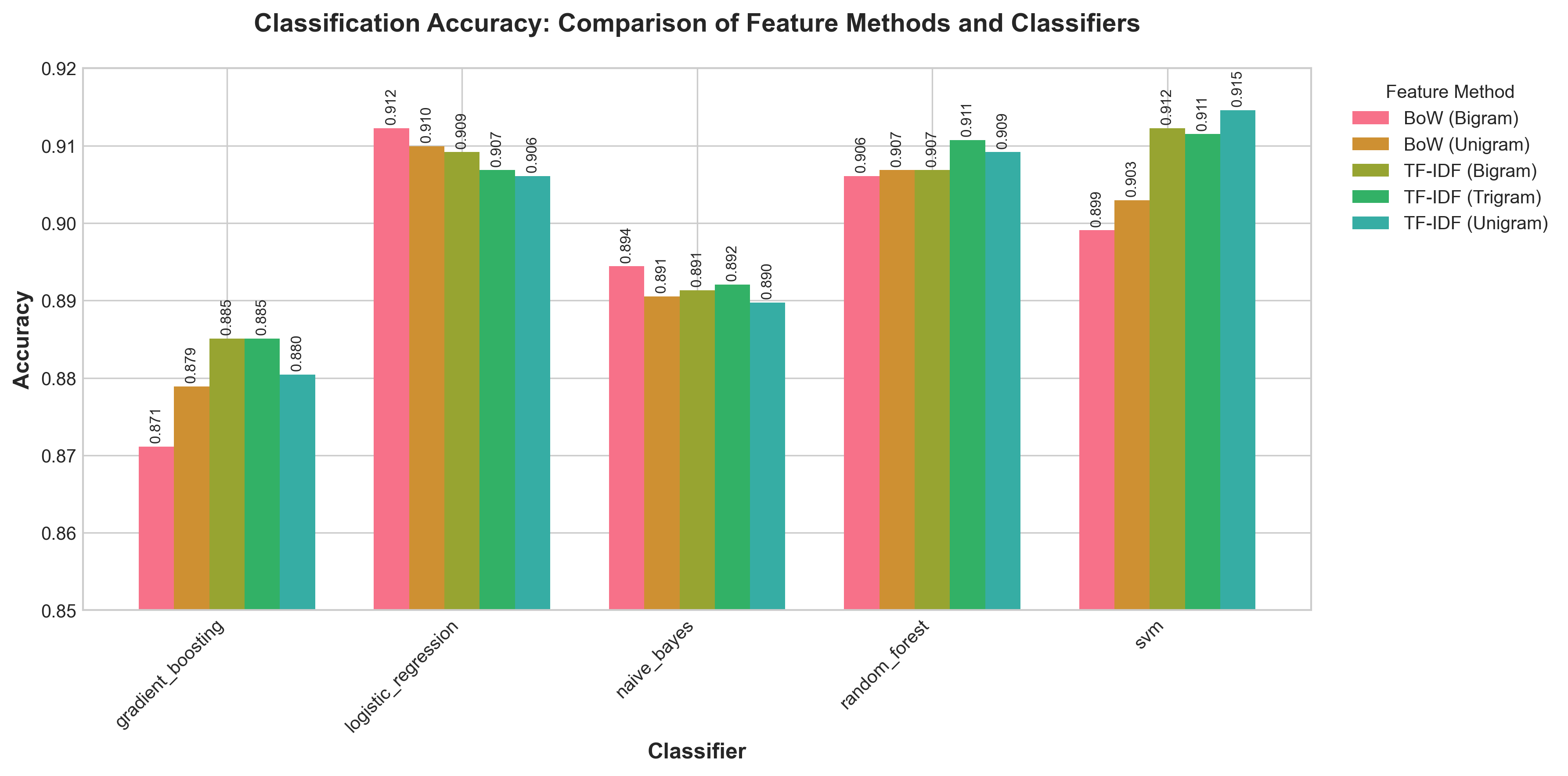
Grouped bar chart of classification accuracy across all feature methods and classifiers, with values annotated on each bar.
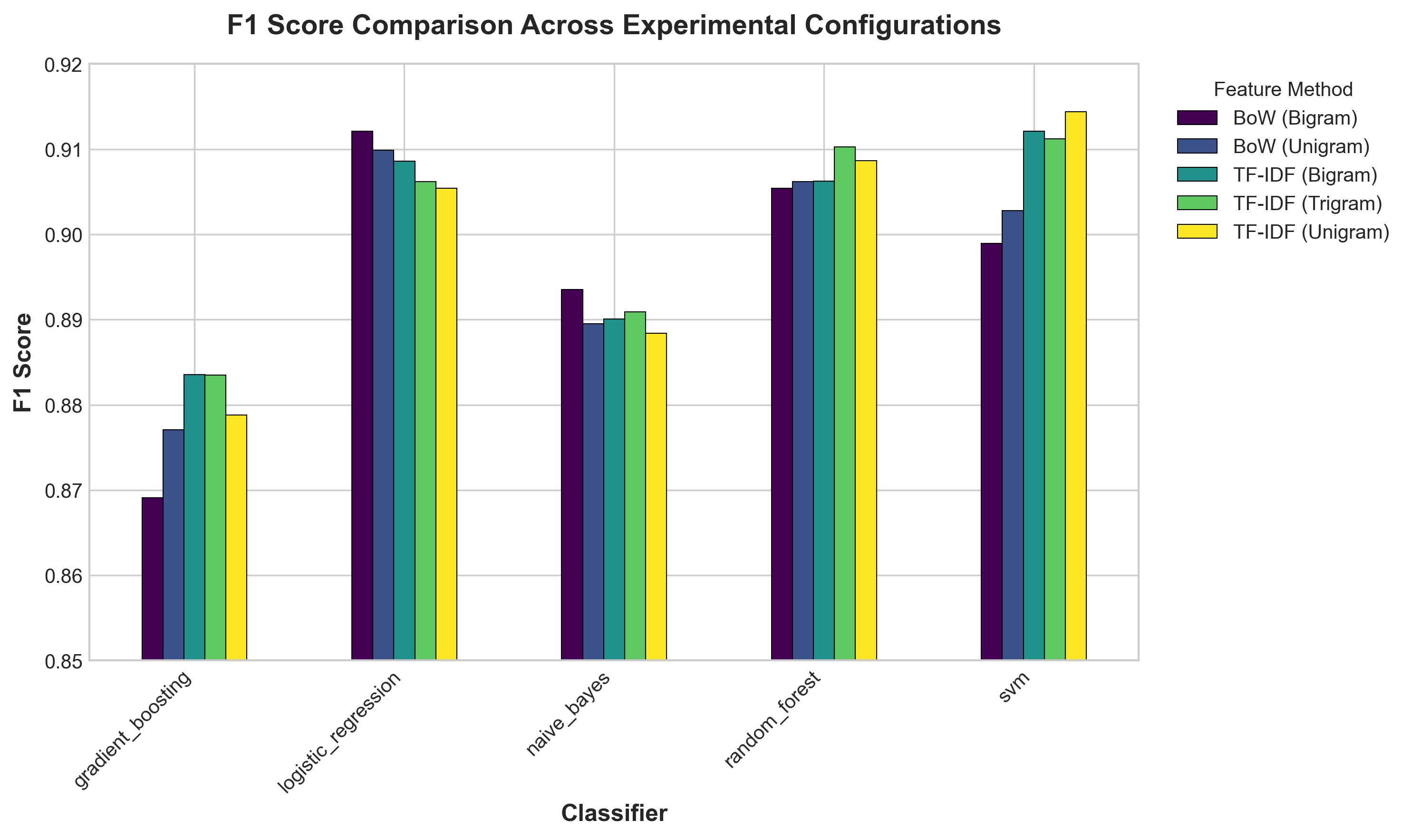
Weighted F1-score across all 25 experimental configurations.
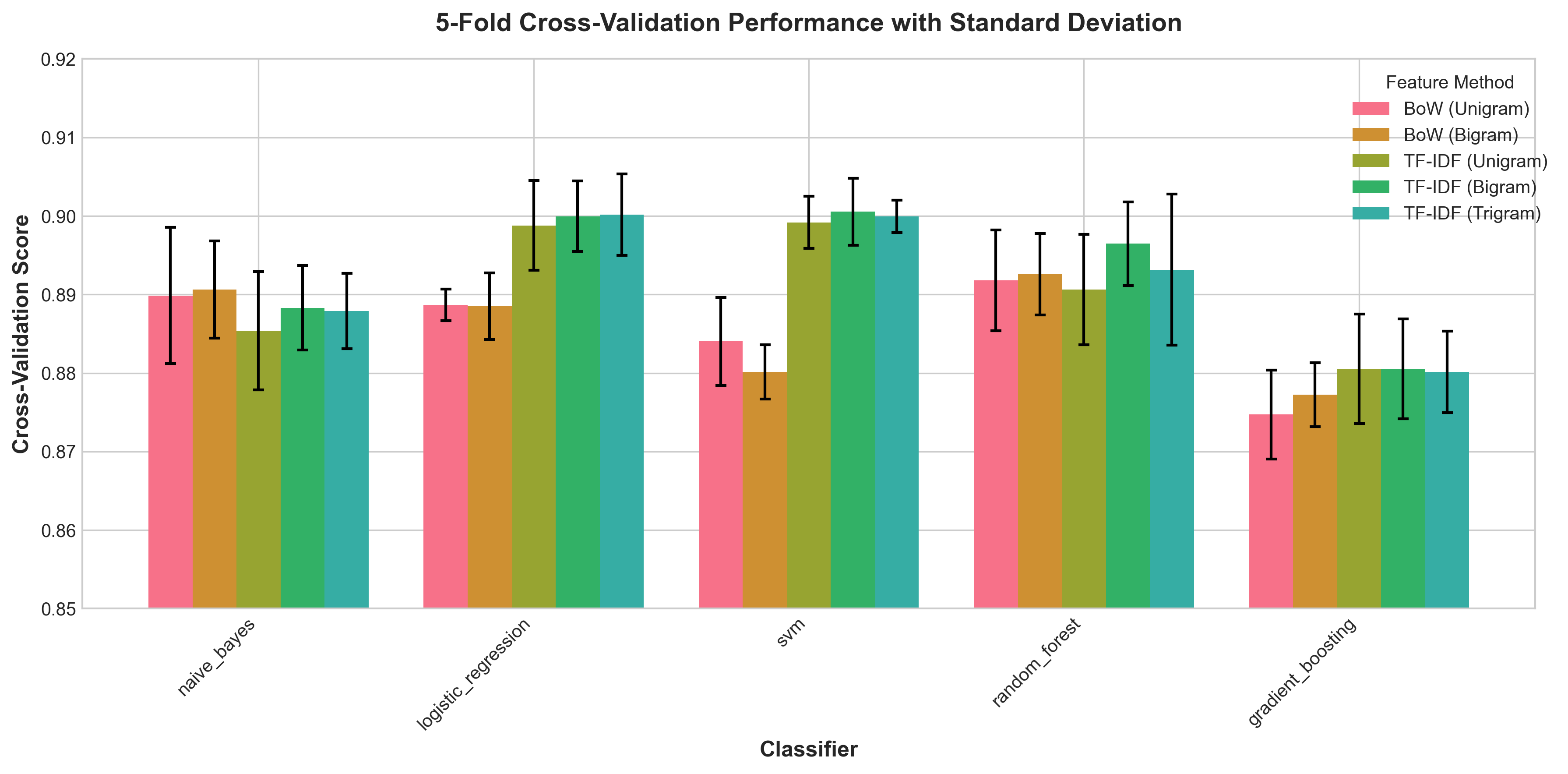
5-fold CV performance with standard deviation error bars showing stability.
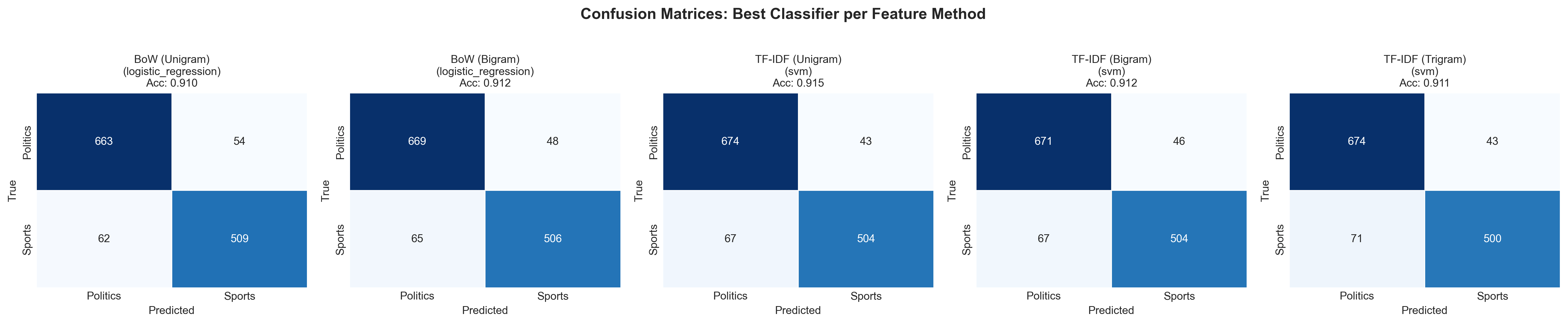
Best classifier per feature method. Note the asymmetry: sports articles misclassified as politics more often than the reverse.
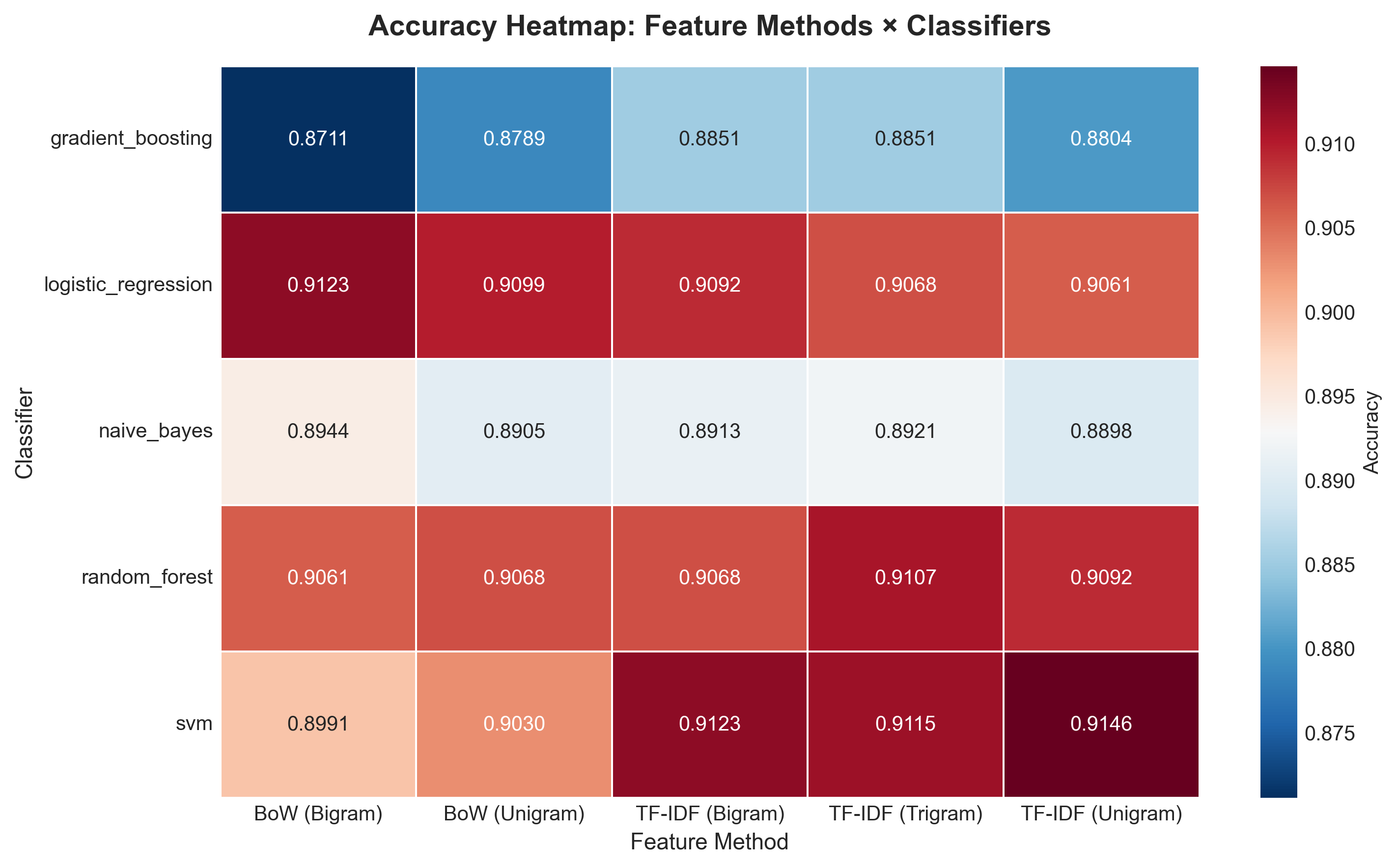
Feature methods × classifiers grid. Darker red = higher accuracy.
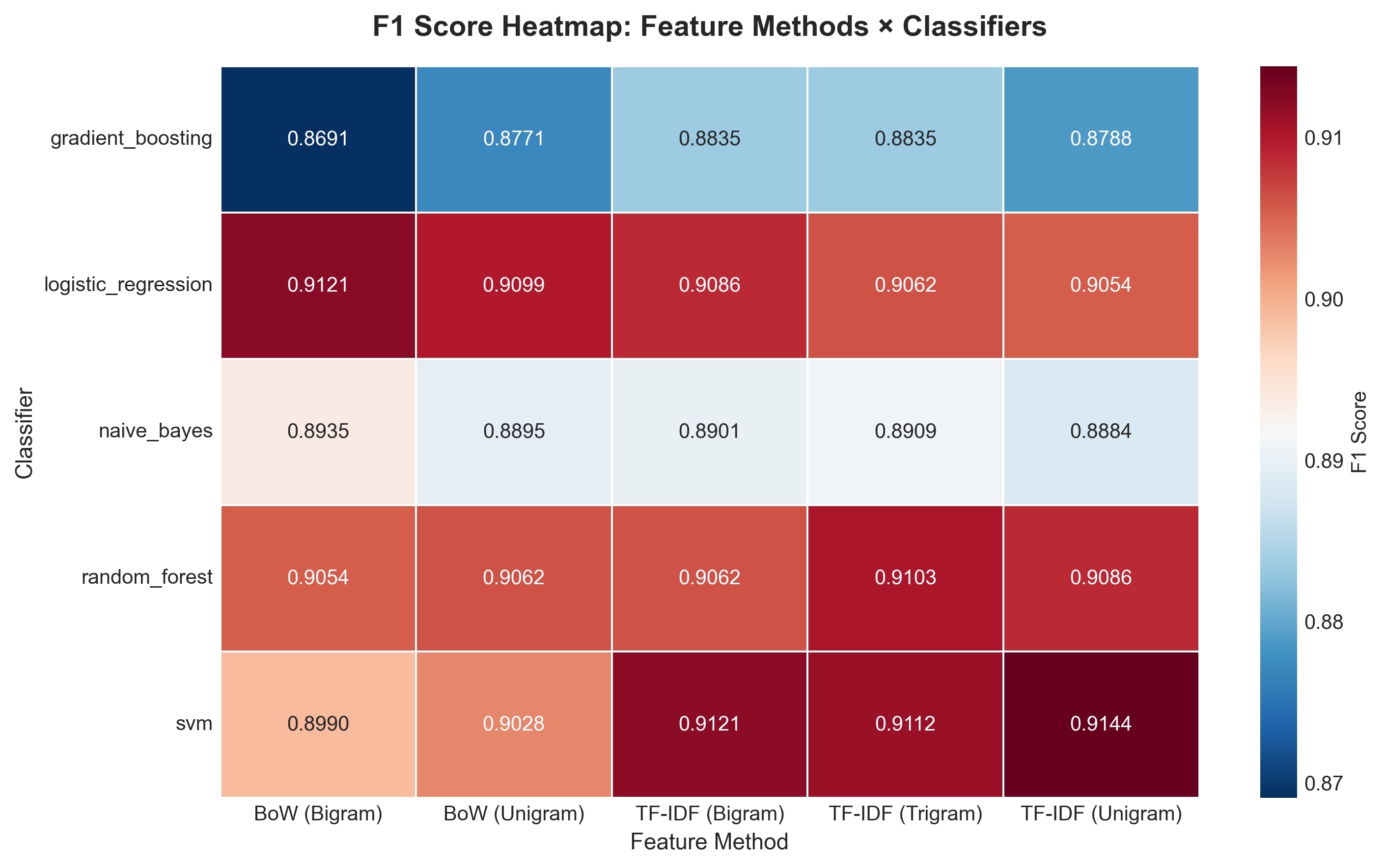
Weighted F1 heatmap mirroring the accuracy pattern closely.
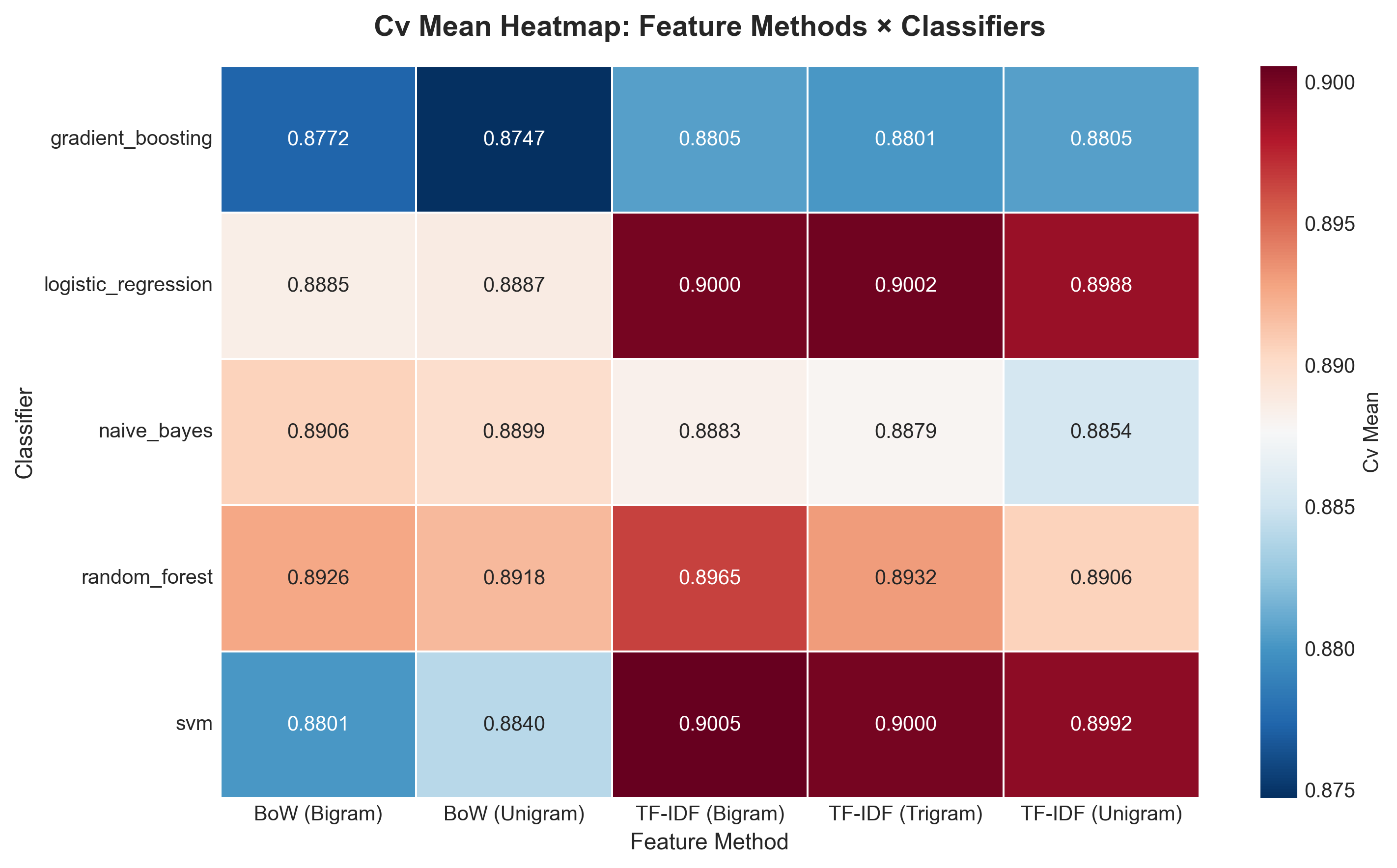
Cross-validation mean accuracy. TF-IDF features dominate the warm end.
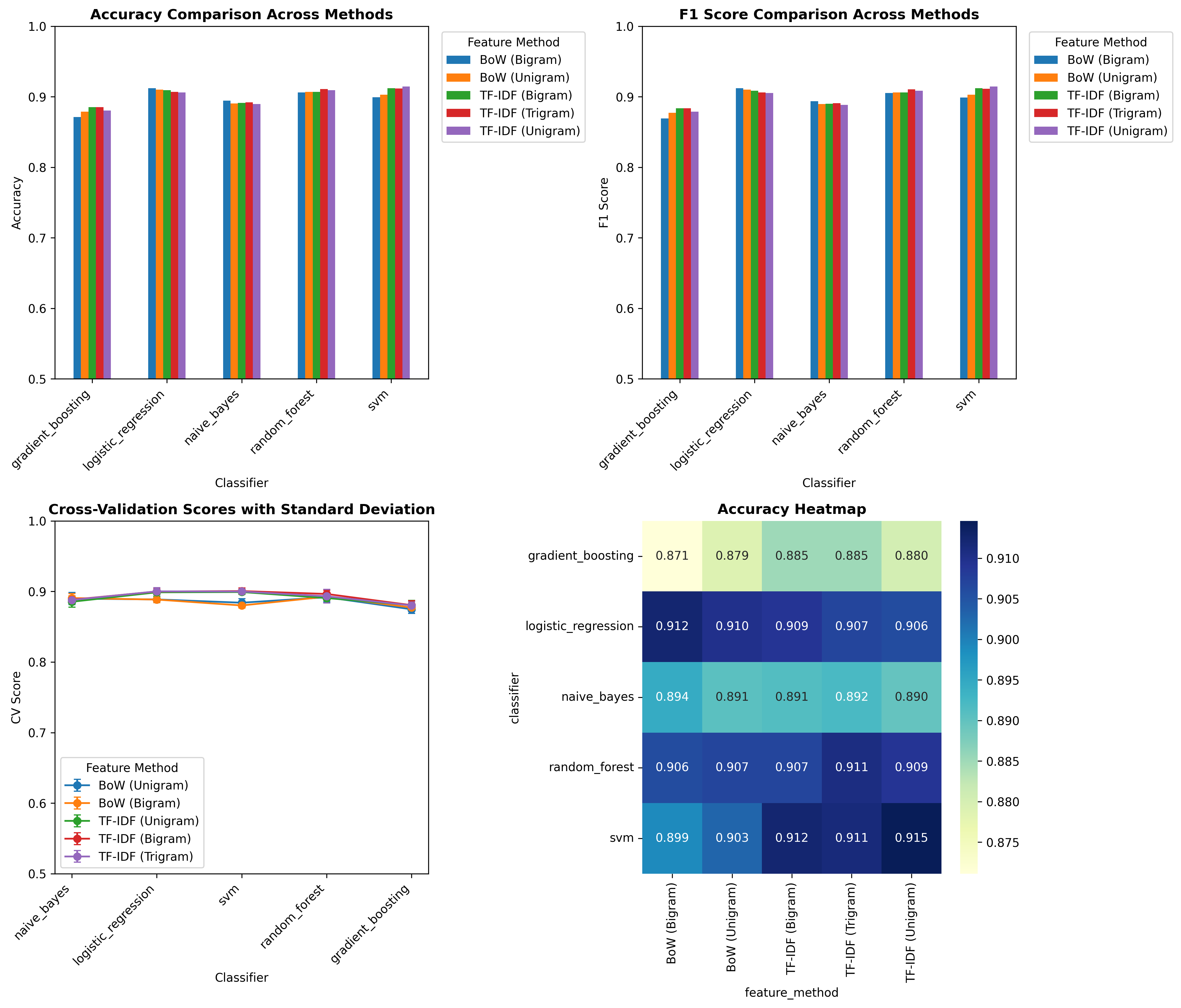
Four-panel overview: accuracy, F1, CV scores, and heatmap in one figure.
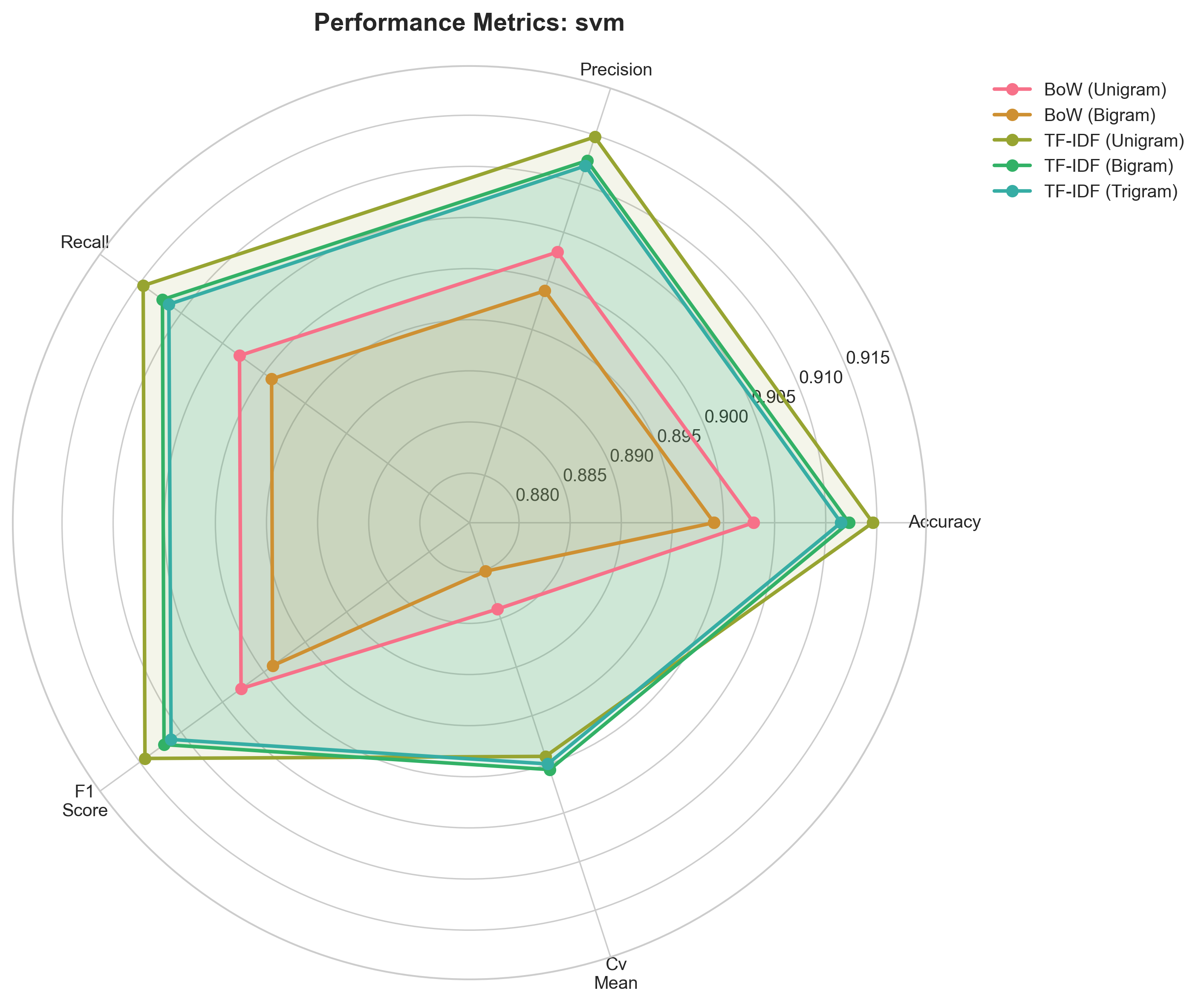
Multi-metric profile. TF-IDF features push the polygon outward on all axes.
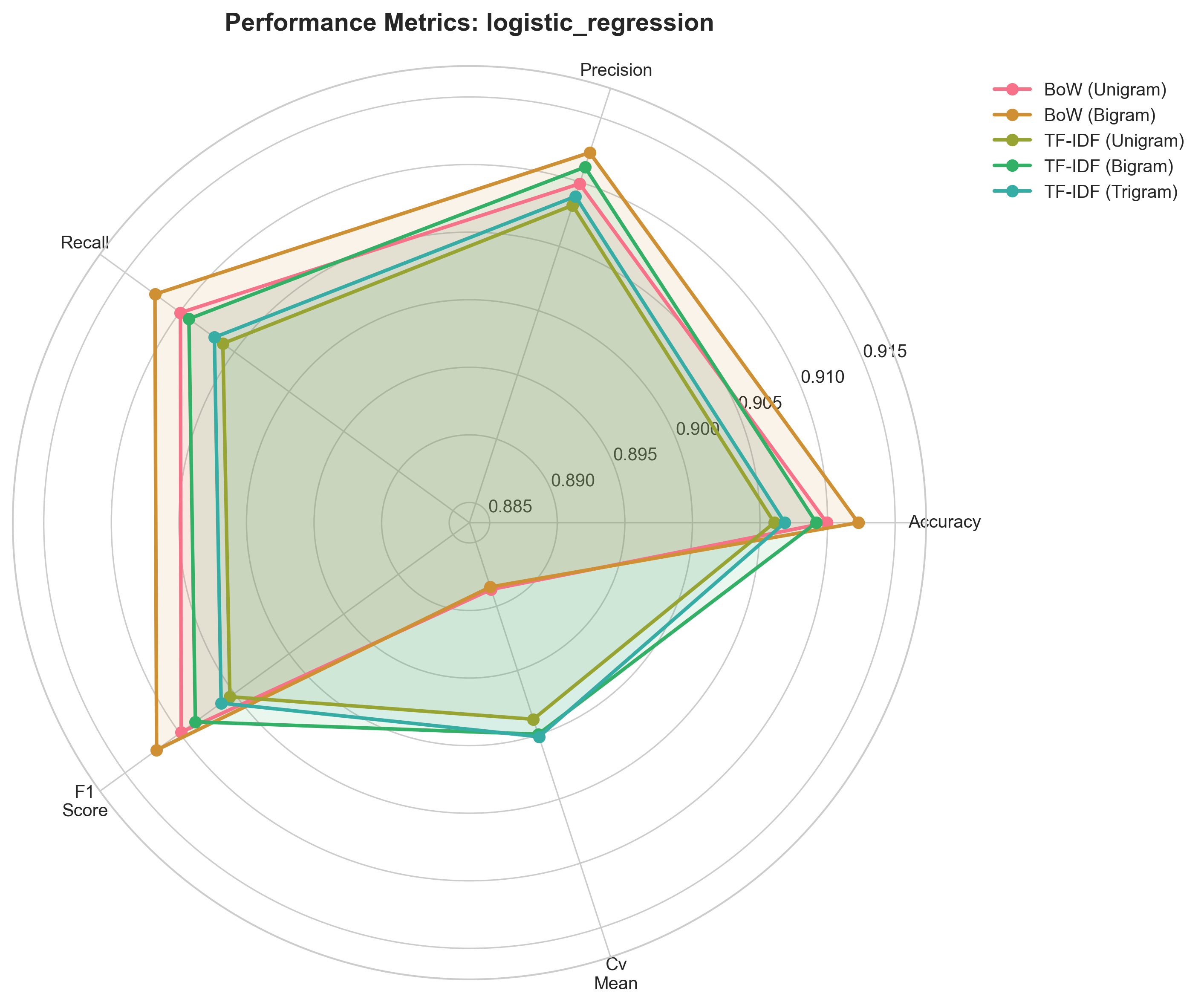
BoW (Bigram) dominates here, unlike SVM where TF-IDF leads.
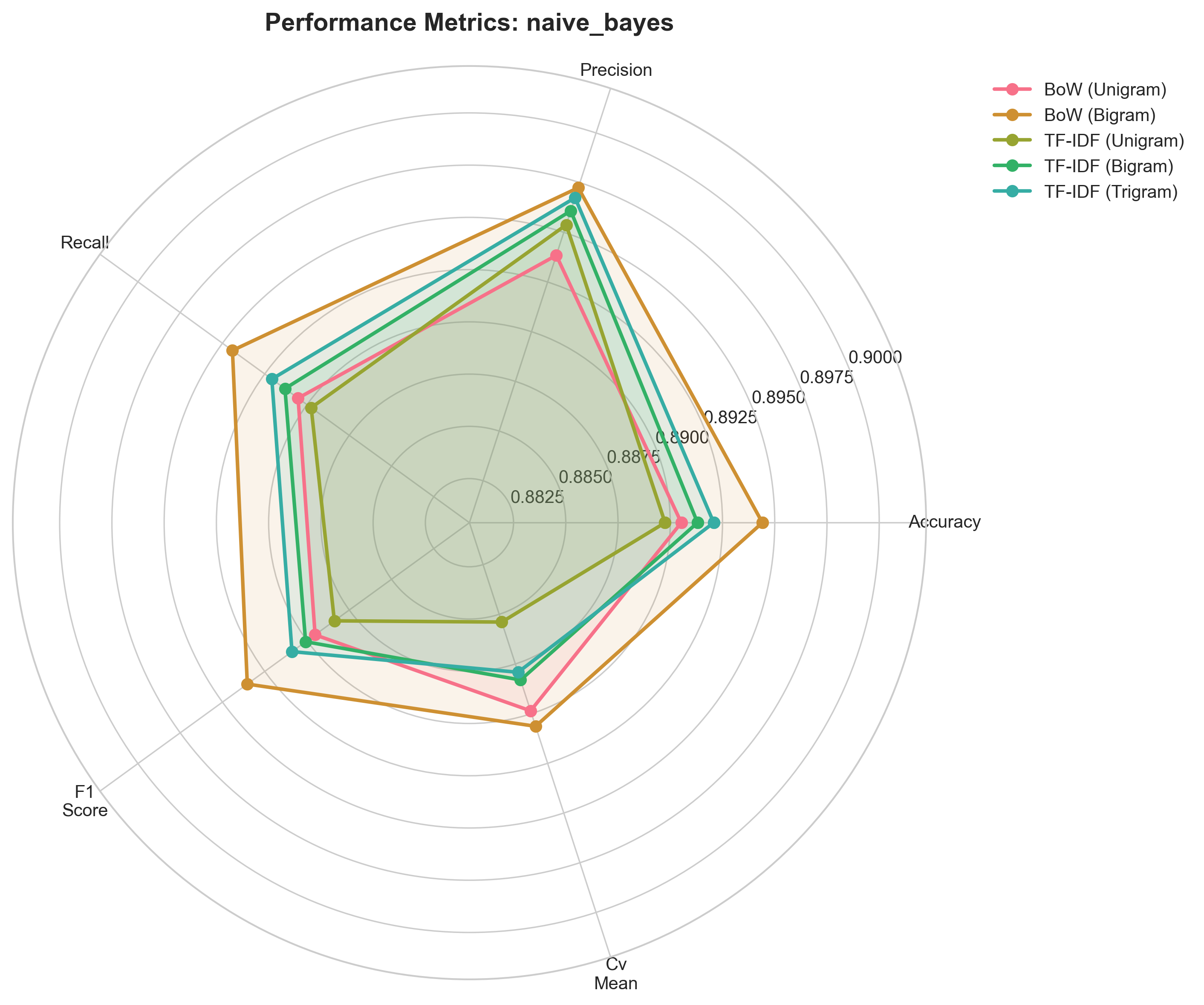
Most compact polygon among the three, reflecting lower overall scores.
Across every classifier, TF-IDF representations yielded higher accuracy than raw count vectors. The SVM saw the most dramatic gain: 89.91% with BoW (Bigram) jumped to 91.46% with TF-IDF (Unigram)—a 1.55-point lift from weighting alone. The inverse document frequency term down-weights ubiquitous tokens and amplifies rare but discriminative ones.
SVM and Logistic Regression consistently claimed the top positions regardless of feature method. This is expected: text feature spaces are high-dimensional (5,000 features), sparse, and approximately linearly separable for well-separated topic categories. The ensemble methods—built for low-dimensional dense features—could not leverage their non-linear capacity effectively.
For SVM, TF-IDF (Unigram) actually outperformed both bigram and trigram variants. The max_features=5000 cap forces a trade-off: as the n-gram range grows, the 5,000 slots are spread across unigrams, bigrams, and trigrams rather than concentrating on the strongest unigrams. Bigger n-gram ranges need proportionally larger feature budgets.
Despite dominating tabular data benchmarks, Gradient Boosting finished last in every feature configuration, trailing the leader by 2–4 percentage points. The greedy, sequential tree construction struggles with the extreme sparsity of text vectorizations—most splits involve features that are zero for the vast majority of documents.
All models misclassify more sports articles as politics than the reverse. Under the best configuration, 67/571 sport articles were mislabeled (11.7% error) versus 43/717 politics articles (6.0%). Political coverage occasionally discusses sporting events in a policy context (stadium funding, doping regulation), creating boundary cases that blur the decision surface.
Type any news headline or article excerpt, pick a model, and see the prediction in real time — powered by Hugging Face Spaces.